Last updated 7 August 2026. This page was reviewed on that date. Prices, rates and opening hours change often in Singapore — confirm anything that matters directly with the business before you travel or spend.
Quick answer: For specialized training formats in Singapore, four names stand out: Atlas Fitness (personal training studio in Novena), Evolve MMA (martial arts academy with multiple Singapore locations), Tribody Fitness (small-group training with in-house osteopathy), and F45 Training (45-minute HIIT circuit franchise). (Looking for full-service multi-club gyms instead? See our guide to full-service and multi-club gyms in Singapore.)
You want a personal training studio that helps you feel confident in your own skin, not just another unused membership. The right fit depends on your schedule, comfort with group classes, and honestly, what you’re willing to pay. Some studios bundle extras like osteopathy or martial arts—useful if you’ll actually go. Others keep it simple with no-contract sessions and straight-talking coaches. Ultimately, results come from showing up regularly.

Atlas Fitness Coaching and Consulting
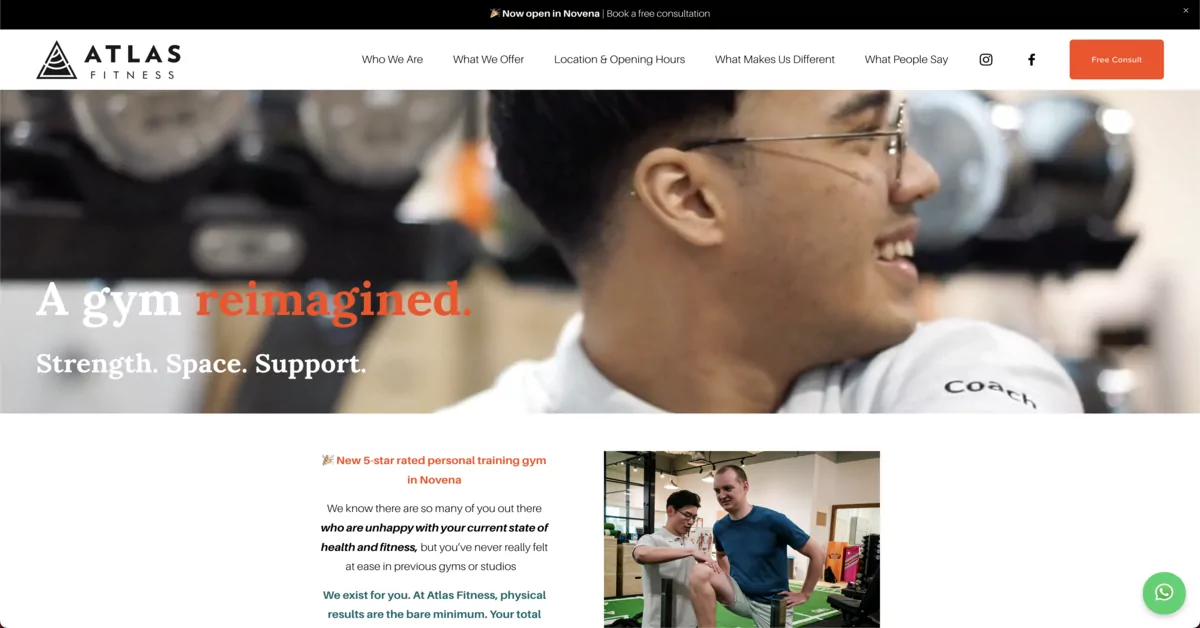
Atlas Fitness Coaching and Consulting Pte. Ltd. is a personal-training studio in Novena offering complimentary, scientifically-grounded fitness consultations.
If your body has been sending you pain signals you cannot decode, this is the sort of place that sits down with you like a mechanic reading an engine light. They map the discomfort against your movement patterns first, not your calendar, so you know if the ache is a training error or a desk-job artifact. Come here when you want the diagnosis before the prescription; skip it if you are just looking for someone to count reps while you chase a pump.
The initial consultation unfolds in a quiet, uncluttered room where the pace is deliberately slow. There is no music pounding, no neon slogan urging you to push harder. The trainer watches you move through simple ranges, asks mechanical questions about when and how the pain started, and uses that data to explain what is really going on under your skin. To get the most out of it, come ready to describe your discomfort honestly, even if the details feel trivial. The atmosphere is more like a private tutorial than a gym induction, so you leave with a clear map instead of a generic workout list.
Products or Services
Coach-supervised training, customized training plans, nutrition and lifestyle planning, monthly body measurements, and goal tracking — covering fat loss, strength & conditioning, muscle building, and pain/injury management.
Contact Information & Location
- Location: Monville Mansion, #01-07, 530 Balestier Road, Singapore 329857 (across from Zhongshan Mall)
- Contact: WhatsApp +65 8842 5535
- Operating Hours: Mon, Wed, Fri: 7:30am-12:30pm & 5pm-9pm; Tue, Thu: 5pm-9pm; Sat: 8:30am-12:30pm; Sun: Closed
- Website: Atlas Fitness
If you’re the sort who likes seeing your numbers move in the right direction, Atlas in Novena keeps things refreshingly clinical. The consultation sets a baseline, and monthly measurements track real change—no guessing. It’s a studio that suits anyone rebuilding after an injury or chasing specific body composition goals, with coaches who don’t just count reps but also map your meals.
Evolve MMA

EMMA I Pte. Ltd., operating as Evolve MMA, runs multiple martial arts academies across Singapore covering Muay Thai, Brazilian Jiu-Jitsu, MMA, boxing, kickboxing, and wrestling.
When the stress sits in your shoulders like a clenched fist and you need a physical release that does not ask you to talk about it, the heavy bag does the listening. This place gives you a clear, technical outlet—each discipline is a different language for the same frustration. It suits you if you want the pain to be instructive, a shin conditioning you can track. It is wrong for you if you need a quiet, corrective touch for a specific joint that already hurts.
Stepping into an Evolve class is like entering a rhythm you didn’t know you needed. The studio hums with the thud of shins on leather and the sharp exhale of effort. You’ll be paired up for pad work, so don’t be shy—grab a partner and commit to the drill, even if you’re clumsy at first. The instruction is clear and technical, leaving no room for overthinking. To really benefit, leave your ego at the door and let the repetition teach your body. Afterward, the kopitiam downstairs becomes a quiet debrief with your training mates.
Products or Services
Classes across 6 martial arts disciplines for all skill levels, plus a complimentary introductory class for newcomers.
Contact Information & Location
- Orchard Central: 181 Orchard Road, #06-01, Singapore 238896 — Phone: +65 6238 1989 — Mon-Fri 6:30am-11pm, Sat-Sun 7am-10pm
- KINEX: 11 Tanjong Katong Road, #02-52, Singapore 437157 — Phone: +65 6288 2293 — Mon-Fri 6:30am-11pm, Sat-Sun 6:30am-9pm
- Star Vista: 1 Vista Exchange Green, #02-26A, Singapore 138617 — Phone: +65 6539 9590 — Mon-Fri 6:30am-11pm, Sat-Sun 8am-9pm
- Also at Raffles Place (Cross Street Exchange) — check their locations page for the full current list.
- Website: Evolve MMA
For anyone whose gym routine has gone stale, Evolve MMA offers six disciplines under one membership—so you can punch out stress on Monday and roll on the mats by Wednesday. The complimentary intro class lets you test the waters without commitment. It’s high-energy, well-structured, and works especially well if you thrive on variety and learning actual skills alongside your conditioning.
Tribody Fitness

Tribody Fitness Pte. Ltd., founded in 2018 by Carol, Ann, and Markus, combines small-group training with in-house osteopathy at its Joo Chiat studio — a combination the brand says is unique among Singapore gyms.
The real difference here is that the person watching your squat also understands the mechanics of your spine at a clinical level. If your back acts up and you are tired of guessing whether to stretch or strengthen it, the in-house osteopathy means the training and the treatment speak to each other directly. This is for you when the pain is a moving target and you need one team to track it. Look elsewhere if your body is currently pain-free and you just want to be drenched in sweat.
You notice the difference the moment you step in: the atmosphere is focused and unhurried, with a palpable sense that your body is being read, not just worked. The coach might pause the session to gently press along your spine or guide a hip release, and because the osteopathy lens is always on, the advice feels seamless rather than fragmented. It is ideal when you want your rehab and your strength work to stop pulling in opposite directions. To settle in, treat the initial chat like a full debrief—mention that old skiing fall or the way your knee feels in the morning. The value lies in connecting those dots.
Products or Services
60-minute small-group sessions with warm-up/cool-down and periodized strength and agility programming, plus in-house osteopathy (the head trainer is also a trained osteopath). No contracts or joining fees.
Contact Information & Location
- Location: 50 Joo Chiat Place, Singapore 427774
- Phone: +65 9852 7607
- Email: [email protected]
- Operating Hours: Mon-Thu 6am-11:15am & 6pm-8:15pm; Fri 6am-11:15am; Sat 8am-11:45am; Sun 9am-11:15am
- Website: Tribody Fitness
Tribody Fitness in Joo Chiat makes a strong case for small-group training that doesn’t overlook aches and pains. Having an osteopath on the training floor means niggles get addressed before they become injuries—a rare perk. The 60-minute classes move with purpose, and the no-contract setup removes that paiseh feeling if your schedule shifts.
F45 Training

F45 Training Outram Pte. Ltd. brings the global F45 franchise’s 45-minute functional/HIIT/circuit training format to the Tiong Bahru/Outram area.
This is a space where the workout is pre-built and the thinking is done for you, which matters when your mental bandwidth is already chewed up by life. The format is a reliable, high-intensity circuit that leaves very little room for indecision. Go here when you need the endorphin hit and the functional strength but do not have a specific injury that needs unpicking. If something already hurts in a way that has a name, a big-group HIIT floor is not the place to fix it.
You arrive, and the workout is already laid out on screens overhead, a fast-moving circuit that pulls you along with the beat and the group’s momentum. The beauty is in the mental offload: no planning, no counting reps, just moving to the next station when the buzzer sounds. You find yourself pushing harder because the collective energy is infectious, high-fiving your neighbour between sets. To sink into the rhythm, let the trainers know if a movement feels awkward—they will swap in an alternative on the spot without breaking your flow. It is a place where you can switch off your brain and let your body follow the pack.
Products or Services
45-minute group workouts combining functional training, HIIT, and circuit training; at-home workouts via the F45 app; certified trainers.
Contact Information & Location
- Location: 261 Outram Road, Singapore 169057
- Phone: +65 8341 6891
- Operating Hours: Mon-Thu 6am-8:30pm; Fri 6am-7pm; Sat 8:30am-1:30pm; Sun 8am-12pm
- Website: F45 Training Tiong Bahru
F45 at Outram delivers that efficient, screen-guided burn that gets you in and out before your kopi-o gets cold. The 45-minute format is predictable but in the best way—you know exactly what you’re signing up for. For busy professionals near Tiong Bahru who just want to get the work done without planning their own sessions, it’s a steady, air-conditioned choice.
At a Glance
| Brand Name | Type of Training | Location |
|---|---|---|
| Atlas Fitness Coaching and Consulting Pte. Ltd. | Personal training | Novena |
| EMMA I Pte. Ltd. (Evolve MMA) | Martial arts | Multiple locations |
| Tribody Fitness Pte. Ltd. | Small-group training + osteopathy | Joo Chiat |
| F45 Training Outram Pte. Ltd. | HIIT & circuit training | Outram / Tiong Bahru |
Read next
Frequently Asked Questions
What’s the difference between this list and your full-service gyms guide?
These four are specialized single-format studios — personal training, martial arts, small-group, and HIIT circuits. Our full-service and multi-club gyms guide covers broader, multi-location gym chains instead.
Is this a ranking of the best training studios?
No. This is a directory of four established specialized training studios to help you compare options — it isn’t an endorsement or ranking, and it doesn’t cover every reputable studio in Singapore.
Disclaimer: Information here has been compiled from the businesses’ own websites, current as of July 2026, and may change. We do not guarantee it is complete or error-free and disclaim liability for inaccuracies or omissions; let us know if you spot an error so we can correct it.