
Rewriting Corporate Services from the Ground Up
For Kelvin Mun, founder of Swiftly Pte. Ltd., the motivation behind Swiftly began with a clear observation. In an industry where incorporating a company typically takes days, Swiftly has reduced the process to minutes. Even straightforward tasks were delayed by outdated processes and excessive back-and-forth communication.
Determined to address this inefficiency, Mun rebuilt the experience from the ground up, introducing automation and system-driven workflows to eliminate friction. Today, Swiftly can generate incorporation documents within seconds of payment, significantly reducing incorporation timelines from several days to minutes. For entrepreneurs, the impact is highly practical. Processes that once involved days of repetitive back-and-forth emails, manual paperwork, and administrative uncertainty can now be completed in a far more seamless manner.
Instead of navigating fragmented workflows, clients are able to move from payment to incorporation readiness within minutes, significantly reducing friction during one of the most important stages of starting a business. Early challenges, however, were less technical than cultural—requiring a shift in long-standing industry mindsets while maintaining strict standards of accuracy and compliance.

Navigating Innovation in a Regulated Landscape
Operating in a highly regulated environment has required Swiftly to carefully balance innovation with compliance. Precision, auditability, and adherence to regulatory standards remain non-negotiable, even as the company pushes for greater efficiency.
At the same time, market perception presented an additional hurdle. Many clients were accustomed to traditional service models, making education and trust-building essential. As clients experience the platform’s speed and reliability firsthand, skepticism has gradually given way to confidence.
Beyond Digitisation: A System Redesign
Swiftly is not simply digitising corporate services—it is helping redefine how the industry itself may operate in the future. In a sector historically dependent on manual coordination, fragmented workflows, and lengthy processing times, Swiftly operates as one of the few fully system-driven platforms within the corporate services industry.
While many traditional firms still rely heavily on manpower supported by partial technology, Swiftly has rebuilt the operational model from the ground up. The company’s infrastructure challenges long-standing assumptions that corporate services must necessarily be slow, labour-intensive, and administratively complex.
Recognition and Industry Momentum
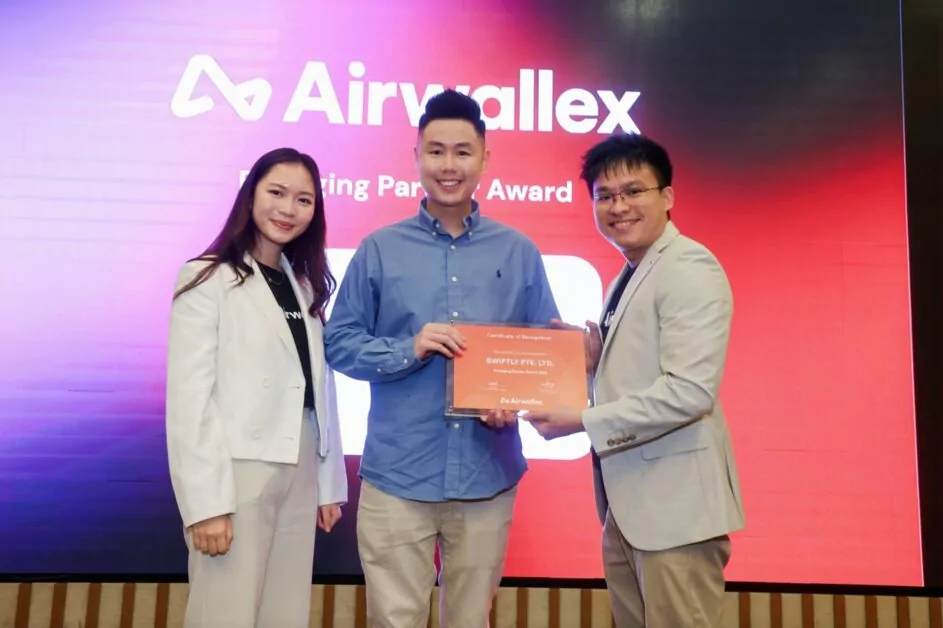
Swiftly’s rapid growth—marked by a 4,000% revenue increase—has been matched by a wave of industry recognition, including multiple award nominations that position the company among the most promising innovators in corporate services.
Importantly, this growth was driven not by proportional manpower expansion, but by operational leverage created through automation and infrastructure design. Swiftly’s systems enable large portions of the onboarding and incorporation process to run with minimal human intervention, allowing the company to scale efficiently while maintaining consistency, compliance, and service quality. This operational scalability has become one of Swiftly’s strongest competitive advantages.

The company’s momentum is reflected not only in its growth, but also in its efficiency. Incorporation documents are generated within seconds of payment, companies can move from onboarding to incorporation readiness within minutes rather than days.

Spanning areas such as innovation, fintech enablement, and business transformation, these nominations reflect a broader industry shift toward automation-driven models that prioritise both speed and precision. As traditional approaches face increasing pressure to evolve, Swiftly challenges the long-standing assumption that corporate services need to be slow and manual.
Redefining Efficiency in Compliance-Heavy Environments
For Swiftly, efficiency is not about speed alone, but about removing unnecessary friction while enhancing precision. In regulated industries, compliance is embedded directly into the system rather than treated as a separate step.
The company’s philosophy is clear: the fastest process should also be the safest. Speed that introduces risk is not efficiency, but haste. By design, Swiftly ensures that the correct way of doing things is also the easiest.
By embedding compliance directly into automated workflows, Swiftly demonstrates that regulated industries do not need to choose between speed and governance. Instead, the company’s model suggests that automation can strengthen operational reliability while simultaneously improving efficiency.
From Manual Workflows to Instant Execution
Swiftly’s ability to generate incorporation documents within seconds is rooted in a simple insight: corporate services are largely repetitive and process-driven. The company broke this down into three key elements—standardising legal logic, structuring client inputs, and automating document generation.
The breakthrough came from recognising that legal documents are assembled based on predefined logic rather than written from scratch. By translating this logic into a system, Swiftly transformed a process that once took days into one completed in seconds, without compromising accuracy.
Designing Within the Boundaries of Compliance
There have been moments where innovation had to be slowed to meet compliance standards. Rather than viewing regulation as a constraint, Swiftly treats it as a core design requirement.
Features that did not meet internal compliance benchmarks were delayed or reworked, prioritising long-term trust over short-term speed. These decisions ultimately strengthened the company’s credibility and operational foundation.
Bridging Tradition and Technology
Through his leadership of both Swiftly and Margin Wheeler, Mun brings a dual perspective to the industry. Margin Wheeler represents the traditional model—built on relationships, depth, and trust—while Swiftly demonstrates the possibilities unlocked by automation.
Together, they point toward a hybrid future: one that combines the reliability of established firms with the speed and efficiency of technology.
Challenging the Speed vs. Quality Myth
A common misconception among new clients is that speed comes at the expense of quality. Swiftly addresses this by demonstrating that well-designed automation reduces human error and improves consistency.
As clients engage with the platform, this perception shifts quickly, revealing that efficiency and accuracy are not mutually exclusive.
From Rapid Growth to Sustainable Scale
Swiftly’s 4,000% revenue growth reflects strong market demand for speed, clarity, and simplicity in a traditionally complex industry. Yet Mun sees sustainability—not growth alone—as the long-term objective.
The company continues to invest heavily in infrastructure, workflow architecture, and automation systems, refine its processes, and maintain service quality as it scales. Its systems are designed not only to meet current demand, but to support exponential future growth without compromising efficiency or customer experience.
The Enduring Role of Human Judgment


Despite its automation-driven model, Swiftly recognises that certain aspects of corporate services will remain human. Judgment, trust, and relationship-building cannot be replaced by technology.
Instead, the company envisions a future where automation handles repetitive tasks, enabling professionals to focus on nuanced decision-making and advisory work.
A Defining Moment of Validation
One of Swiftly’s most meaningful milestones came in a simple yet powerful moment: watching a client complete incorporation within minutes. What was once a time-consuming and stressful process had become seamless.
For Mun, this was more than operational success—it was validation of a broader belief that corporate services are entering a new era. As automation infrastructure becomes increasingly sophisticated, the industry may gradually shift away from heavily manual coordination toward scalable, system-driven service models where speed, compliance, and accuracy are built directly into the operational foundation.
Yet Swiftly does not see technology as a replacement for human expertise. Instead, the company envisions a future where automation handles repetitive execution while professionals focus on judgment, strategy, and client relationships. In doing so, Swiftly is not only building a faster corporate services platform, but helping shape what the next generation of corporate services may ultimately look like.
Advice from Kelvin for Aspiring Entrepreneurs

Kelvin Mun
Founder of Swiftly Pte. Ltd.
Be very careful about whose advice you take.
In the early stages, it’s easy to seek guidance from others, but not all advice is equal. Many people give well-intentioned suggestions based on their own limited experience, and if you follow everything blindly, it can actually slow you down or steer you in the wrong direction.
Over time, I’ve learned that it’s important to stay grounded in your own conviction, especially if you have a clear understanding of the problem you’re solving.
Listen broadly, but filter aggressively. At the end of the day, you’re the one closest to your business, and you’re the one accountable for the outcome.